Category: Uncategorized

  • Which Phone Models Should Your Custom Cases Cover? Planning SKUs Around a Fragmented Lineup

    Which Phone Models Should Your Custom Cases Cover? Planning SKUs Around a Fragmented Lineup

    The hardest decision in a bulk custom phone case order is not the artwork or the material. It is deciding which phones the cases actually fit. A case body is molded to one specific model, so every device you want to cover is a separate SKU, a separate mold, and a separate quantity line. Order too many models and you tie up cash in slow-movers; order too few and you turn away buyers whose phone you skipped. Getting the model spread right is what separates a clean sell-through from a box of dead inventory, and the market data gives you a clear place to start.

    The Market Splits Before You Even Choose a Design

    Where your buyers live decides your first split. In the United States, iPhone leads with roughly 58 percent of the smartphone market against about 42 percent for Android, based on 2025 figures. Flip to a global or price-sensitive audience and the ratio inverts hard: worldwide, Android held about 72.8 percent in late 2025 against 26.8 percent for iOS. If you are selling cases to a US retail crowd, weighting your order toward iPhone is defensible. If your audience is international, or skews younger and more budget-conscious, planning an iPhone-heavy run will leave a large part of your market uncovered.

    This is why the same case design can succeed or fail purely on model planning. A design boutique selling to US professionals and a promotional reseller shipping worldwide should not order the same spread of bodies, even if the printed graphic is identical. Decide the audience and its geography first, because that percentage split caps how far your budget can sensibly stretch across the two ecosystems.
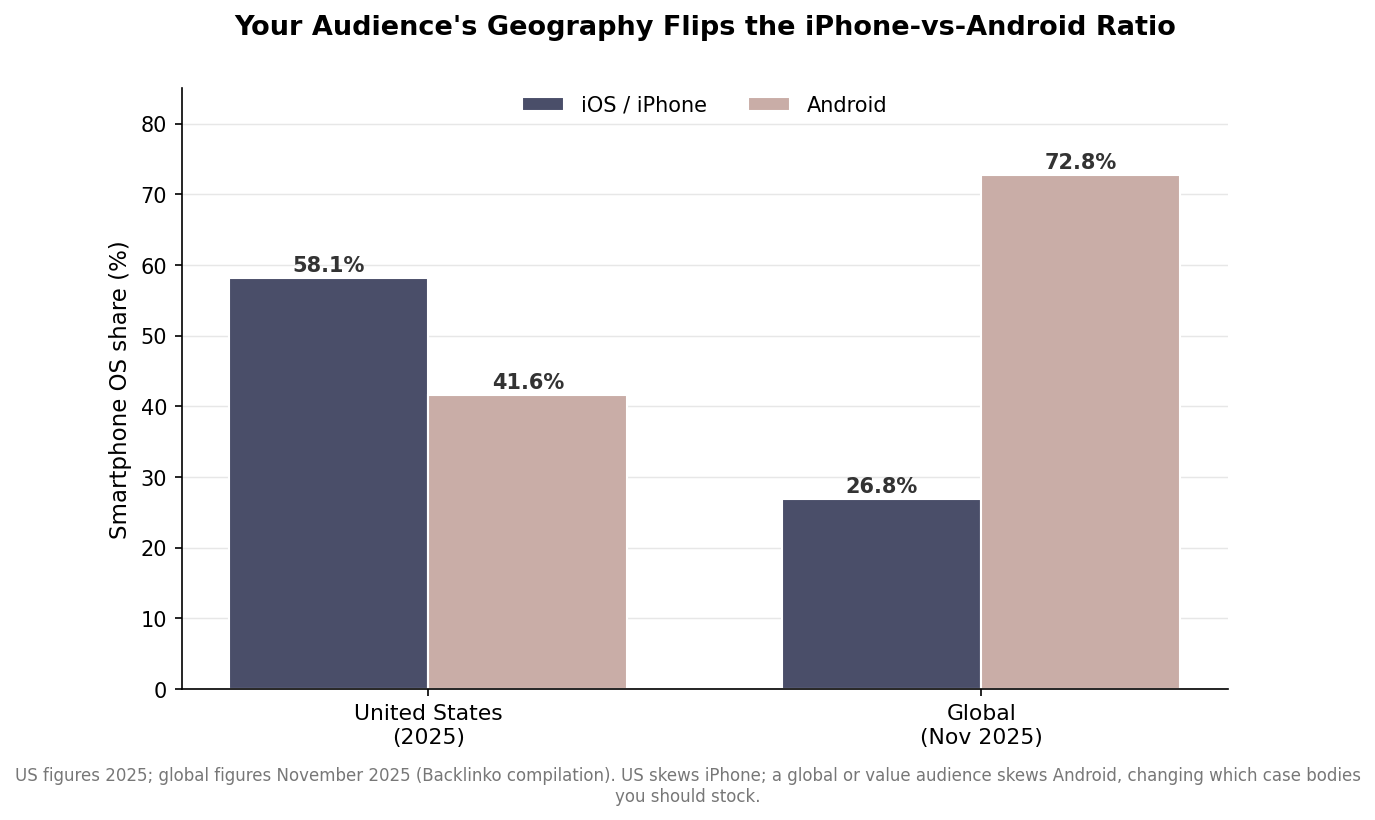
    Grouped bar chart comparing iOS and Android share in the US (58 vs 42 percent) and globally (27 vs 73 percent)
    The US leans iPhone while the global market leans Android, which should reset your model spread.

    No Single iPhone Model Owns the Room

    Even once you commit to iPhone, there is no safe single model to standardize on. As of mid-2026, the most-used iPhone was the iPhone 13 at only about 11.9 percent of the active base, followed by the iPhone 15 and iPhone 16 Pro near 11 percent each and the iPhone 17 Pro around 10.6 percent. The important pattern is that the leader sits near twelve percent, not fifty. Demand is spread across a long tail of models spanning several years, because people keep phones for years and buy across the lineup, from the newest Pro Max down to hand-me-down older units.

    For a case buyer, that fragmentation is the whole challenge. Covering just the single most popular model reaches barely one in eight iPhone owners. Reaching a meaningful majority of iPhone users means stocking a handful of models across at least two or three generations, which multiplies your SKU count and your total order. The realistic goal is not full coverage but smart coverage of the models that concentrate the most demand for your specific audience.
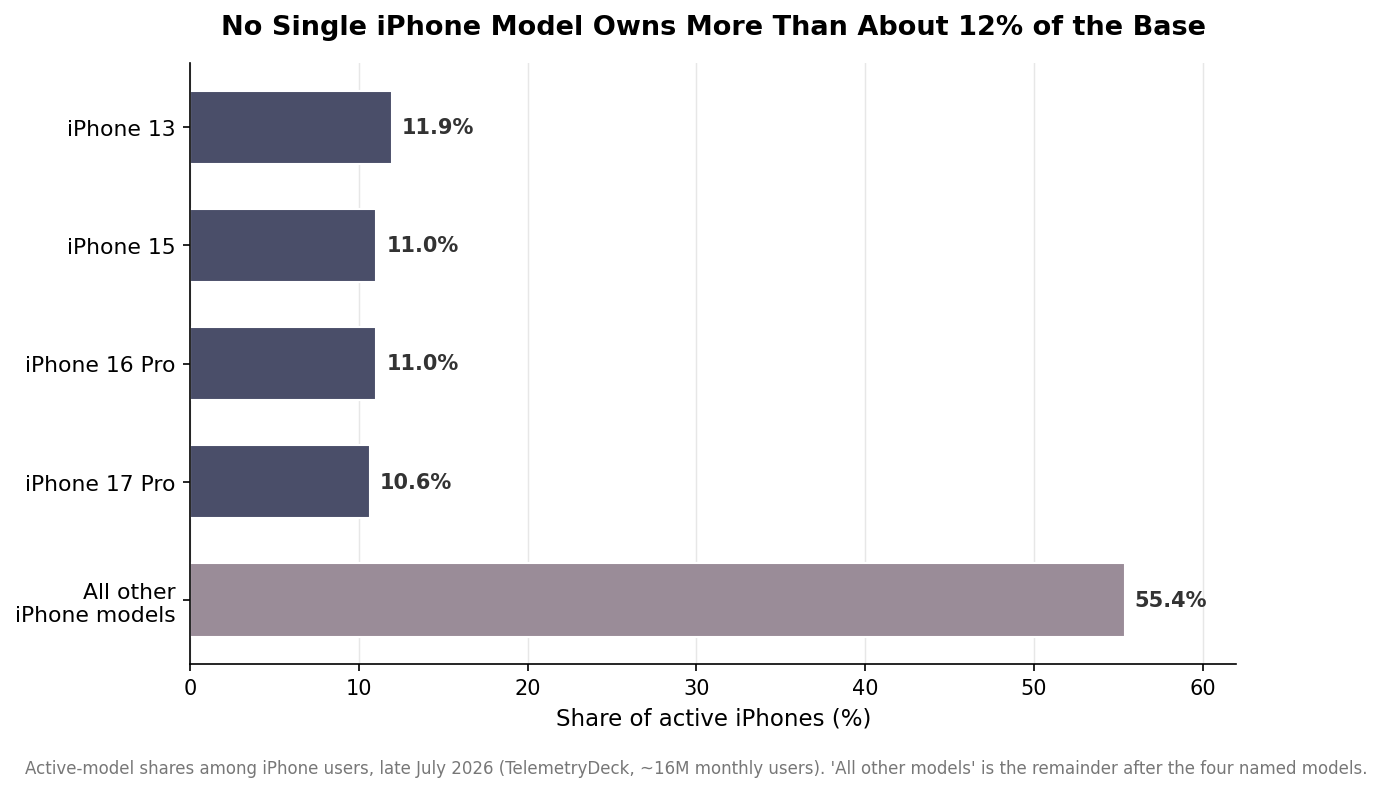
    Horizontal bar chart of active iPhone model share in July 2026: iPhone 13 at 11.9 percent, iPhone 15 and 16 Pro near 11 percent, iPhone 17 Pro at 10.6 percent, all other models 55.4 percent
    Even the most-used iPhone model holds only about 12 percent, so demand spreads across many SKUs.

    Match Your SKU Spread to Your Audience

    Translate those shares into a plan by working from the top down. Start with the current flagship generation, since new-phone buyers are the most likely to want a fresh case, then add the one or two prior generations that still hold double-digit share. A common, defensible starting spread is the newest standard and Pro sizes plus the previous generation’s equivalents, which captures recent buyers without gambling on older models that are aging out. Add Android bodies in proportion to the audience split from the first section rather than as an afterthought, and if you serve a global market, a leading Samsung Galaxy flagship or two belongs in the plan.

    Quantity per model should follow share, not vanity. It is better to order deeper on three or four proven models than to spread a thin, identical quantity across a dozen bodies, because the thin approach guarantees you sell out of the popular ones while the rare-model cases sit. Let the percentage each model commands guide how many units you commit to it, and hold a little budget back to reorder the winners once real sales tell you which bodies move.

    Where Model Planning Goes Wrong

    The most common mistake is ordering for the phone in your own pocket instead of the market. Your personal device is one data point out of a fragmented field, and a run built around it usually misses where demand actually sits. A close second is chasing the brand-new model too aggressively at launch, before its share has climbed, which leaves you holding cases for a phone whose owners have not all upgraded yet. The opposite error, clinging to a model that is sliding down the charts, leaves you with bodies that fit fewer phones every month.

    Two mechanical mistakes hurt just as much. Forgetting that each model needs its own quantity line turns a tidy budget into a much larger commitment once you add the fifth or sixth SKU. And ignoring size-family overlaps, where a standard and a Plus of the same generation are different molds, quietly doubles your count when you assumed one case would serve both. Map every model and size to its own line before you total the order, so the SKU count does not surprise you at checkout.

    A Simple Model-Coverage Plan

    Put it on one page before you buy. Name your audience and its rough iPhone-to-Android split, list the current flagship generation and the one or two prior generations worth covering, decide which Android bodies the split justifies, and set a per-model quantity weighted toward the highest-share devices. Confirm the quantity for each SKU and add the size variants as separate lines. Then keep a reorder reserve so you can go deeper on whatever actually sells. A plan built on where phones actually are, rather than on the one you happen to own, is the difference between cases that move and a shelf of bodies that fit almost nobody.
  • What “MagSafe Compatible” Really Means for a Custom Phone Case

    What “MagSafe Compatible” Really Means for a Custom Phone Case

    When a phone case is sold as MagSafe compatible, the label is doing a lot of quiet work. It is a claim about magnets, about wireless charging, and about tolerances measured in fractions of a millimeter. For anyone ordering custom cases at volume, understanding what that claim actually rests on is the difference between a case that snaps satisfyingly onto a charger and one that sags, slips, or refuses to charge at full speed. This explainer breaks down the standard behind the marketing so you can specify a custom case that genuinely lives up to it.

    What “MagSafe compatible” actually means

    Apple’s MagSafe system, introduced on the iPhone 12, combines three things in the phone: a ring of magnets for alignment, a central alignment magnet, and the wireless charging coil beneath them. A genuine MagSafe accessory talks to the phone and can charge at the higher MagSafe rate. Most cases you will see described as MagSafe compatible are not Apple-certified; instead they embed their own magnet ring positioned to line up with the phone’s, so magnetic chargers, wallets, mounts, and stands attach in the right spot. That distinction matters when you write a spec. Compatible cases can align and hold accessories reliably, but the phrase is not a guarantee of certified charging speed, so it is worth stating in your order whether you need certified performance or simply dependable magnetic alignment. The same wording covers a wide quality range, from cases with a full, well-aligned ring to ones with a token magnet that aligns loosely, so treating it as a starting point for questions rather than a finished answer will save you disappointment later.

    Inside the magnet ring

    The heart of a compatible case is a circular array of small neodymium magnets set into the back shell, over the charging zone. Aftermarket rings commonly use high-grade neodymium, often cited as N52, because the grade determines how much holding power you get from a thin, unobtrusive ring. Holding power is the number buyers actually feel: a well-designed magnetic case will resist somewhere in the range of 800 to 1,100 grams of pull before an attached accessory lets go. That is enough to hold the phone on a car vent mount or dangle it briefly from a charger without dropping. Too weak and wallets slide off in a pocket; too strong is rarely the problem. Because the magnets sit under the printed surface, the artwork itself does not interfere, but the ring must be aligned precisely to the phone model, which is why model-specific tooling matters for a custom run.

    Charging speed: MagSafe versus ordinary Qi

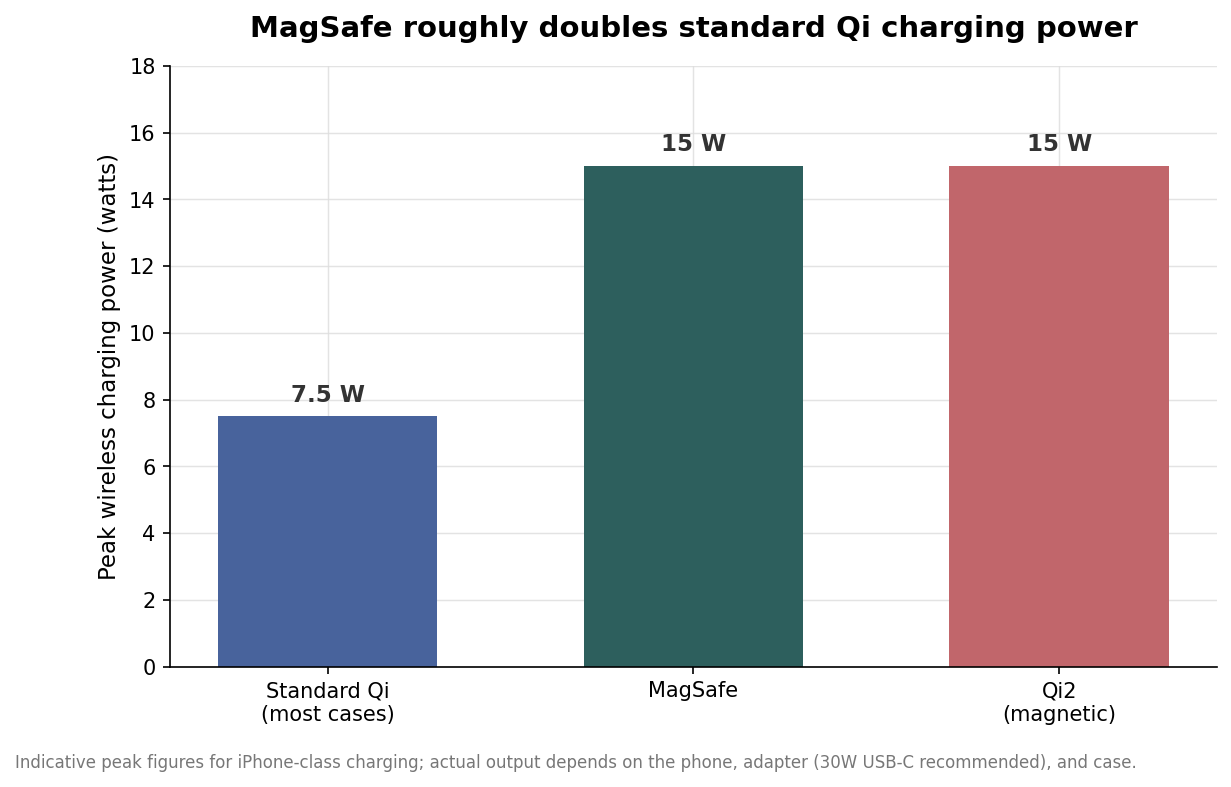
    Speed is where the certified-versus-compatible line shows up most clearly. Apple’s MagSafe charging delivers up to about 15 watts to the phone, roughly double the 7.5 watts that a typical case gets from a standard Qi pad. The newer Qi2 standard borrows MagSafe’s magnetic alignment ring and also targets 15 watts, which is bringing magnetic, faster wireless charging to a wider range of phones beyond Apple’s. To reach those peak figures the phone generally needs an adequate power source behind the charger, and Apple recommends a 30-watt USB-C adapter for the fastest results. A compatible case that aligns well but is not certified may still charge, just at the slower Qi rate. The chart below shows the practical gap between these tiers.

    Bar chart comparing peak wireless charging power for standard Qi, MagSafe, and Qi2
    MagSafe and Qi2 target about 15W, roughly double a standard Qi case.

    Why case thickness is the make-or-break spec

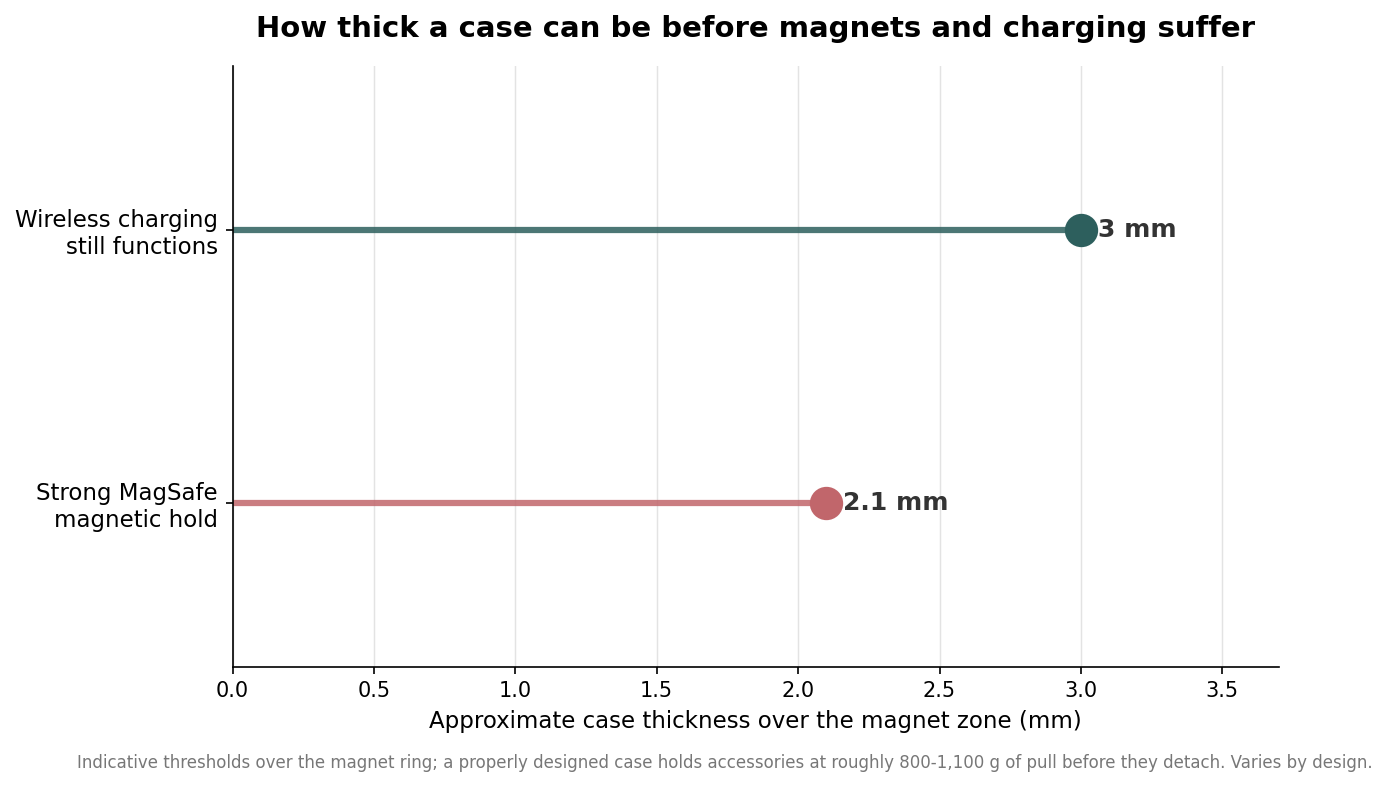
    Wireless charging and magnets both work across a gap, and that gap is mostly your case. As a rough guide, ordinary wireless charging keeps functioning through a case up to about 3 millimeters thick over the coil, while a strong, satisfying MagSafe-style magnetic hold really wants the shell over the ring to sit closer to 2.0 to 2.1 millimeters. Every extra fraction of a millimeter weakens both the magnetic grip and charging efficiency, which is why rugged, thick-walled cases sometimes struggle with accessories even when they include magnets. There is also a hard rule about materials: metal plates, metallic foils, or metal-flake finishes over the charging zone can trigger the phone’s Foreign Object Detection, which shuts charging down to prevent overheating. For custom cases this means keeping the magnet-and-coil zone to non-metallic materials and inks. The chart below plots those thickness thresholds side by side.

    Dot plot showing case thickness thresholds for magnetic hold and wireless charging in millimeters
    Thinner shells over the magnet zone give a stronger hold and better charging.

    Built-in magnets versus add-on rings, and what to confirm before ordering

    There are two ways to make a custom case magnetic, and they suit different orders. The first is an embedded ring, where the magnet array is built into the case during manufacturing; this is the clean, durable choice for a branded bulk run because there is nothing for the end user to install or misalign. The second is a stick-on magnetic ring applied to a plain case after the fact, which is cheaper per unit but relies on the buyer placing it correctly and can peel over time, making it a poor fit for a professional product. If you are commissioning custom cases, embedding the ring is almost always the right call. Before you sign off, confirm a short list of specifics with your supplier: which exact phone models the tooling covers, whether the case is certified or simply compatible, the shell thickness over the magnet zone, the rated holding force, and that no metallic material or ink sits over the charging window. The figures in this guide are indicative of current mainstream products and vary by design and manufacturer, so treat them as a checklist to pressure-test a quote rather than fixed guarantees. Nail those points down and MagSafe compatible stops being a hopeful label and becomes a spec you can actually hold the factory to.

  • How to Order Custom Phone Cases in Bulk Without Overpaying

    How to Order Custom Phone Cases in Bulk Without Overpaying

    A bulk custom phone case order is decided long before you see a quote. What lands on your invoice is set by four choices you make up front: how many units you commit to, how many phone models you have to cover, which case body you print on, and how much runway you leave before your deadline. Get those right and a promotional case is one of the most efficient items you can buy. Get them wrong and you either overpay two or three times over or miss the date the cases were meant for.

    This walkthrough goes through those decisions in the order a supplier will ask about them, so you can specify the job cleanly and compare quotes that actually describe the same thing.

    Quantity is the first lever, and the cost breaks are steeper than buyers expect

    Custom phone cases behave like most printed goods: the cost per unit drops quickly as volume climbs, because the fixed cost of setting up artwork spreads across more pieces. The first few hundred units carry most of the savings, and the curve flattens after that. Quotes always depend on the case body, the print method and the number of models, so the useful move is to ask for a quote at two or three quantities and compare how the per-case cost changes.

    Minimum order quantities vary a lot by supplier and method. Some factories set minimums in the hundreds and split them across phone models, while print-on-demand has no minimum at all but charges a premium on every piece. Get Custom Phone Cases sits in between: the minimum order is 12 cases, which is enough to check print and fit on a real handset before you commit to a larger run. Knowing where your order sits relative to those options tells you which kind of supplier to talk to.

    The phone-model problem quietly wrecks budgets

    Here is the trap that catches first-time bulk buyers. A case is molded or cut to a specific handset. Your recipients do not all carry the same phone, so a run of 300 cases for a mixed team or customer base is not one order of 300 identical parts. It is several smaller orders, one per model, each with its own blank, its own artwork adaptation for a different camera cutout, and often its own minimum.

    Suppliers that support this at all usually treat it as multi-model production, which adds setup work and separate packaging per model. The practical fix is to standardize. Decide on the three to five handset models that cover most of your audience and offer only those, rather than promising to match whatever phone each person happens to own. Every model you drop from the list simplifies the order and pulls the cost per case back toward a single-model quote.

    Case type sets your cost baseline

    Before artwork or quantity, the case body itself sets the baseline you are working from. A sublimation-printed polycarbonate shell is the most economical way to put a full-color design in someone’s hand. Flexible TPU and silicone sit a little above that. A tempered-glass-backed case costs more again, and leather or wallet styles more still. Print-on-demand cases, which bundle the case, the print and shipping into one number, are priced per piece and cost the most per case at volume.

    None of these is the “right” choice in the abstract. A giveaway at a trade show wants the lowest defensible cost per piece; a case sold under your own brand can justify glass or leather because the buyer is paying for it. Pick the body first, because it decides which cost band every other number in your quote is measured against.

    Supply artwork that survives the print

    Most avoidable reprints come from artwork, not manufacturing. Cases print to the very edge and wrap around a curved body with a camera cutout punched through the design, so files need to be built for that geometry rather than for a flat rectangle. Supply vector art where you can, or raster art at 300 dpi at the final case size. Extend the background past the trim so color bleeds off every edge instead of leaving a white sliver, and keep anything you cannot afford to lose, such as a logo or key text, well clear of the camera and corner radius.

    Ask the supplier which print method they will use, because it changes what the file should be. UV printing lays ink on the surface and holds crisp edges and fine text well; dye sublimation infuses color into a coated shell and renders photographic gradients smoothly but softens the finest detail. Building the file to the method you are actually getting is the difference between one proof and three.

    Work the lead time backward from your date

    Bulk cases are not a next-day product, so plan from your deadline outward. At Get Custom Phone Cases the free mockup comes back within 24 hours, and a standard order ships in about 2 weeks from approval, with express shipping available for tight dates. Shipping transit time is added on top, and the time you take to review the proof is added as well.

    Add it up and a realistic window from approved artwork to cases in hand is about 2 weeks plus transit, assuming the first proof is clean. If the cases are tied to an event, order against the event date with a buffer for a reprint, not against the earliest date a supplier says is possible. The buyers who get burned are almost always the ones who treated the quoted production time as the whole timeline rather than one segment of it.

    Specify the job in this order and your quotes become comparable: a quantity that fits the supplier type you are talking to, a short and deliberate list of phone models, a case body chosen for how the cases will be used, artwork built for the actual print method, and a deadline with room to recover. That is most of the difference between a smooth bulk order and one that does not.

  • Custom Phone Case Materials and Print Methods: How the Two Choices Shape Each Other

    Custom Phone Case Materials and Print Methods: How the Two Choices Shape Each Other

    The print you get on a custom phone case is never the product of one decision. It is the product of two coupled ones: the material the case is made from and the method used to decorate it. A wraparound photograph that looks flawless on a sublimation-ready hybrid case is not achievable the same way on a soft silicone shell, and a crisp corporate logo that snaps off a UV printer looks different again from one embedded during molding. Understanding how those two choices constrain each other is what separates a case that matches the mockup from one that quietly disappoints at delivery.

    This is a deep dive into that relationship: what the common case materials do, how the main decoration methods actually work, and which pairings hold up.

    The case materials and how each takes a print

    TPU, a flexible thermoplastic, is the default printable material for good reason. It combines flexibility with enough rigidity to hold shape, absorbs impact well, and takes ink with good adhesion, which makes it the go-to surface for detailed full-color work. Polycarbonate sits at the opposite end: rigid, hard, and durable against impact, but with a smoother, less forgiving surface that generally needs extra preparation to hold a print cleanly. Silicone is the softest and most shock-absorbing of the three, pleasant in the hand and resistant to fingerprints, but its very smooth, slightly rubbery surface is the hardest to decorate crisply, so it is usually printed with methods chosen specifically to bond to it.

    Hybrid, or “tough,” cases answer the tradeoff by combining materials, typically a soft TPU bumper around the sides for impact absorption with a harder back panel that provides a flatter, more stable printing surface. That construction is why so many bulk custom cases are hybrids: they protect like a rugged case while giving the decoration a good canvas. When someone specifies a “tough case” for a full-color design, this is usually the reason.

    How the decoration methods actually work

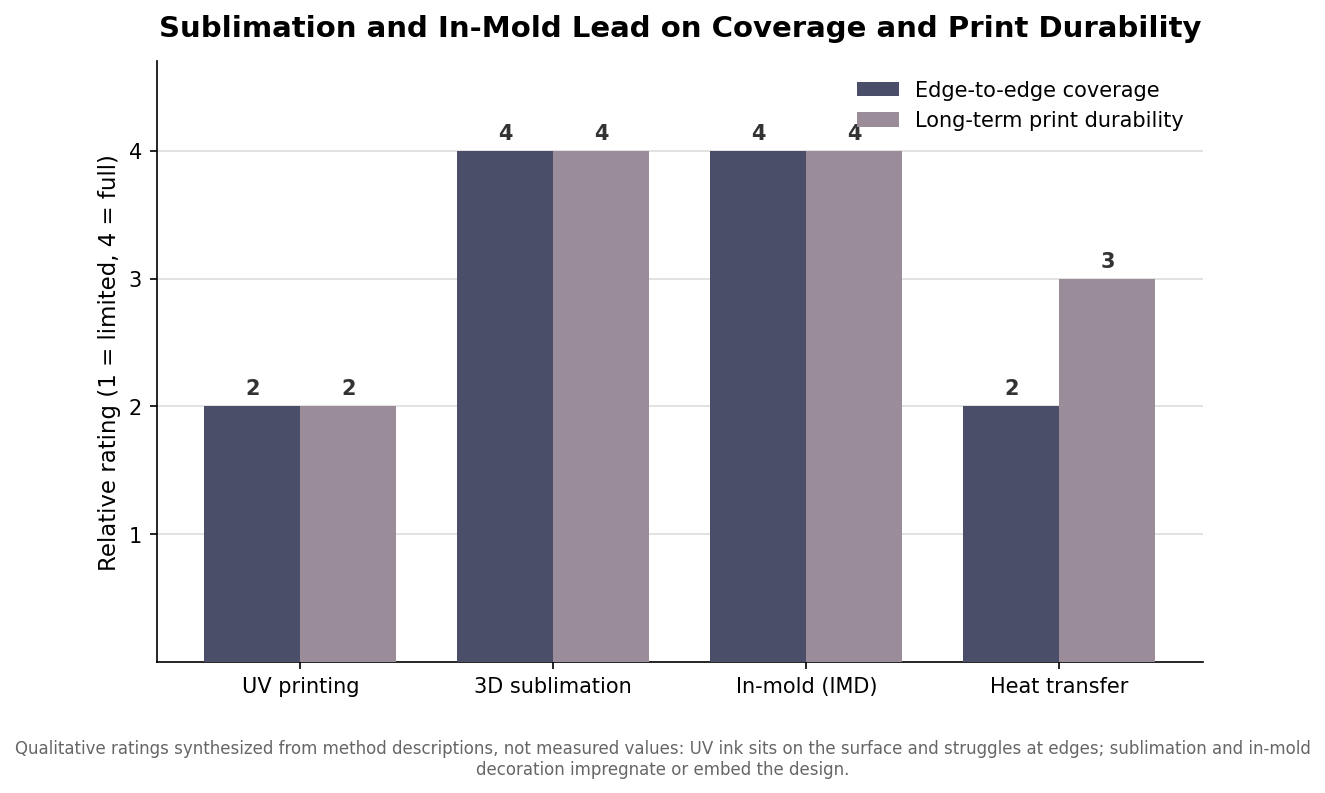
    UV digital printing cures ink onto the surface with ultraviolet light. It handles full color, complex art, and even layered effects like a white underbase or spot gloss, and it produces sharp, high-gloss images because the ink sits on top of the case. Its two honest limitations are that it is difficult to print cleanly all the way to a curved edge, and because the ink is a surface layer rather than infused, it can wear or scratch over long, hard use.

    Dye sublimation takes the opposite path, using heat to convert dye into gas that impregnates the case surface, so the image becomes part of the material and resists flaking, cracking, and fading. So-called 2D sublimation applies the image to a flat insert, while 3D sublimation wraps the dye around curved and raised areas for near-full coverage, which is how photographic, edge-to-edge designs are achieved. In-mold decoration goes further still, embedding the design during the molding of the case itself; the result is permanent for the life of the case, wraps fully, and can even mimic finishes like carbon fiber, wood grain, or brushed steel. Heat transfer rounds out the common set, applying a pre-printed film that supports photographs and resists peeling and fading, but places the image as a discrete transfer rather than a true edge-to-edge wrap.

    The chart below rates these four methods on the two attributes buyers ask about most, coverage and durability. The pattern is consistent: the methods that put the image into or under the surface outperform the one that lays it on top.

    Grouped bar chart rating UV printing, 3D sublimation, in-mold decoration and heat transfer on edge coverage and print durability
    Methods that embed or infuse the design outperform surface printing on both coverage and durability.

    Where material and method have to agree

    The pairing is where specifications succeed or fail. Sublimation needs a case manufactured to accept it, which is why it is offered on specific hard, gel, and TPU cases rather than on any shell you supply. UV printing is the most materially flexible, bonding to plastic, TPU, and even wood or metal accents, which makes it the practical default when you want full color without committing to sublimation-ready stock. Silicone’s smooth surface pushes you toward UV or heat transfer rather than sublimation, and polycarbonate’s rigidity and finish reward methods that either embed the art during molding or are applied with proper surface prep. In short, decide the look you need first, then let it dictate both the case construction and the method together, because choosing one without the other is how a design ends up compromised.

    Clear cases, edges, and the artwork details that trip people up

    Clear cases deserve their own attention because they are popular for showing a phone’s color while carrying a logo, and because they behave differently. The transparency that makes them attractive also makes any print sit against a see-through background, so a design meant for clear stock has to be built for it rather than dropped onto it. Two artwork details cause most reprints regardless of material: bleed and cutouts. Designs intended to reach the edge need extra image beyond the trim so a slight shift during production does not leave a white sliver, and the camera, port, and button openings differ by phone model, so a layout that works for one device will clip important elements on another. Confirming the cutout template for the exact model, and keeping logos and text a safe margin inside the edges, prevents the most common and most avoidable disappointments.

    Quantities, samples, and lead times

    Minimum order quantities on custom cases are lower than many buyers assume, but they vary by case type and by supplier. Some factories set minimums in the hundreds per design, while others will run short batches. At Get Custom Phone Cases the minimum order is 12 cases on every style, which is enough to check the material, the print and the fit on a real handset before committing to a larger run.

    Timelines follow a two-step rhythm: a physical sample to approve, then the production run. At Get Custom Phone Cases the free mockup comes back within 24 hours and a standard order ships in about 2 weeks after approval, with express shipping available for tight dates. Because the approval step exists to catch color, fit, and cutout issues before you commit to a full run, the sensible move is to build it into the schedule rather than treat it as optional, and to plan the whole project backward from the date you need cases in hand. Get the material, method, and artwork aligned, approve a real mockup, and the run that follows is the predictable part.

  • What a Drop Rating Actually Means

    ‘Military grade’ and ‘rugged’ are marketing. A drop test is only meaningful when you know what it consisted of.

    Height without a surface tells you nothing

    A phone dropped from head height onto plywood experiences a fraction of the deceleration of the same drop onto concrete. Any drop claim that omits the surface has omitted the harder half of the test.

    Ask for both. A supplier who has really tested will have both numbers to hand.

    Orientation decides everything

    Corner-first drops are the ones that break phones, because all the energy arrives at one small area. Flat-back drops are comparatively harmless.

    That is why a good tough case has thickened corner sections rather than an even wall, and it is a thing you can see on the sample.

    Once is not the same as repeatedly

    A case that survives one drop from a given height may not survive twenty. Materials fatigue — TPU takes a set, polycarbonate develops micro-cracks around the corners.

    For a field workforce, ask about repeated impacts rather than a single headline figure.

    What the case cannot do

    No case prevents a screen cracking when the phone lands face down on a stone with the glass exposed. A raised bezel helps on flat surfaces and cannot help on a point.

    If screens are what break, the honest answer is a folio that covers the glass, plus a screen protector — not a thicker shell.

  • Eco Phone Cases: What the Claims Actually Mean

    This is the part of the category with the loosest language, so here is what each word means when somebody has to stand behind it.

    Compostable

    A plant-based shell that breaks down under industrial composting conditions: sustained heat, moisture and time. It is a real material difference and it is not a garden-bin product.

    Before specifying one, check that an industrial composting route actually exists where the cases will end up. If it does not, the claim is decorative.

    Biodegradable

    The loosest of the three, because almost everything biodegrades eventually. Without a stated timeframe and conditions the word carries no information at all.

    We do not use it on its own, and we would treat a supplier who does with caution.

    Recycled

    A shell made from diverted polymer, with a percentage you can state and a supply chain that can be evidenced. It behaves exactly like a conventional case.

    For most buyers, and for almost every procurement process, this is the most defensible environmental claim available in this category.

    Packaging counts too

    A compostable case in a shrink-wrapped polybag inside a laminated box is a mixed message that a procurement officer will notice.

    Plastic-free packaging is available and cheap; if the case is being bought for its environmental story, buy the packaging to match it.

    Get it in writing

    Material, recycled percentage, disposal route. We put all three on the quote so they can be cited in a report rather than paraphrased from a product page.

    A claim nobody can check is worth nothing, and it is worse than nothing if somebody checks.

  • The Complete Buyer’s Guide to Custom Phone Cases

    Cases are bought on a picture and judged six weeks later. These four questions predict the second part.

    Construction follows the actual risk

    If phones land on concrete, you want a dual-layer case: a soft inner that absorbs and a rigid outer that spreads. Ask for the drop height and the test surface in writing, because plywood and concrete are not the same test.

    If the real risk is pocket scratches, a slim polycarbonate case is plenty and much nicer to carry. Buying a rugged case for a scratch problem is the most common overspend in this category.

    Bezels are the cheapest protection there is

    A lip standing proud of the screen is what keeps the glass off a table when the phone lands face down. A lip standing proud of the camera ring is what keeps the lens off the same table.

    A flush camera is the single most common false economy in case molding. Look at any case from the side before you buy a thousand of them.

    Charging is a specification, not an assumption

    Ask whether the case charges wirelessly and, if it has magnets, where the array sits. An array positioned to the center of the case rather than to the charging coil will hold the phone confidently in a position that does not charge.

    On folios, a card sitting over the coil will block charging and can warm the card. Slots should be positioned clear of it.

    The model list is what kills case programs

    A branded case ordered for one handset generation is obsolete the month the next one lands, and most programs quietly die there.

    Ask whether the supplier keeps your artwork on file and reprints to new models as they are tooled. It turns a one-off order into a line item that renews itself.

    What to send when you ask for a quote

    Model list, construction, quantities and artwork — plus whether the cases will live on desks, in pockets or on vehicle mounts. That is enough for a real quote and a mockup the same day.

    Camera cut-outs move between models, so artwork usually needs repositioning rather than just rescaling. We do that free.