The hardest decision in a bulk custom phone case order is not the artwork or the material. It is deciding which phones the cases actually fit. A case body is molded to one specific model, so every device you want to cover is a separate SKU, a separate mold, and a separate quantity line. Order too many models and you tie up cash in slow-movers; order too few and you turn away buyers whose phone you skipped. Getting the model spread right is what separates a clean sell-through from a box of dead inventory, and the market data gives you a clear place to start.
The Market Splits Before You Even Choose a Design
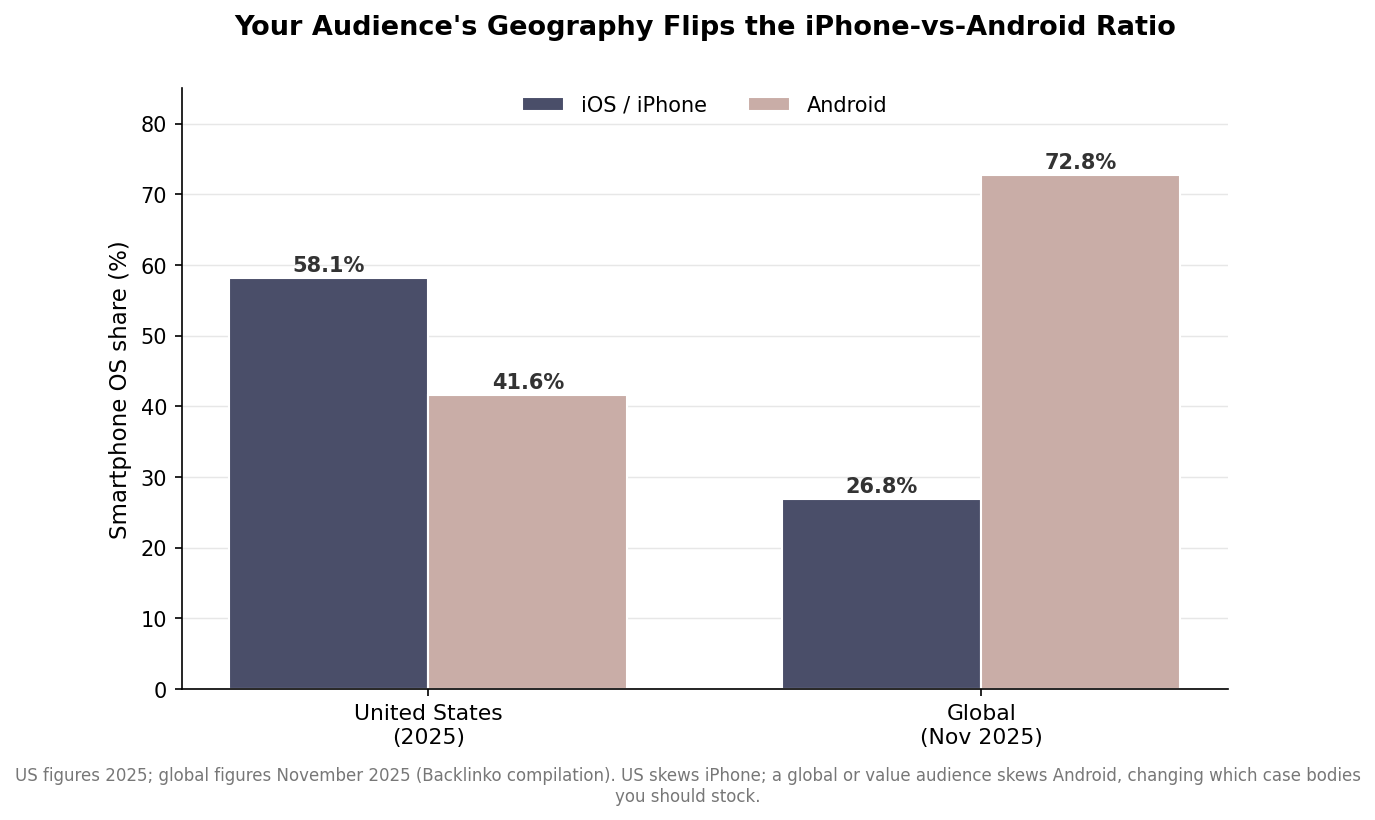
Where your buyers live decides your first split. In the United States, iPhone leads with roughly 58 percent of the smartphone market against about 42 percent for Android, based on 2025 figures. Flip to a global or price-sensitive audience and the ratio inverts hard: worldwide, Android held about 72.8 percent in late 2025 against 26.8 percent for iOS. If you are selling cases to a US retail crowd, weighting your order toward iPhone is defensible. If your audience is international, or skews younger and more budget-conscious, planning an iPhone-heavy run will leave a large part of your market uncovered.
This is why the same case design can succeed or fail purely on model planning. A design boutique selling to US professionals and a promotional reseller shipping worldwide should not order the same spread of bodies, even if the printed graphic is identical. Decide the audience and its geography first, because that percentage split caps how far your budget can sensibly stretch across the two ecosystems.
No Single iPhone Model Owns the Room
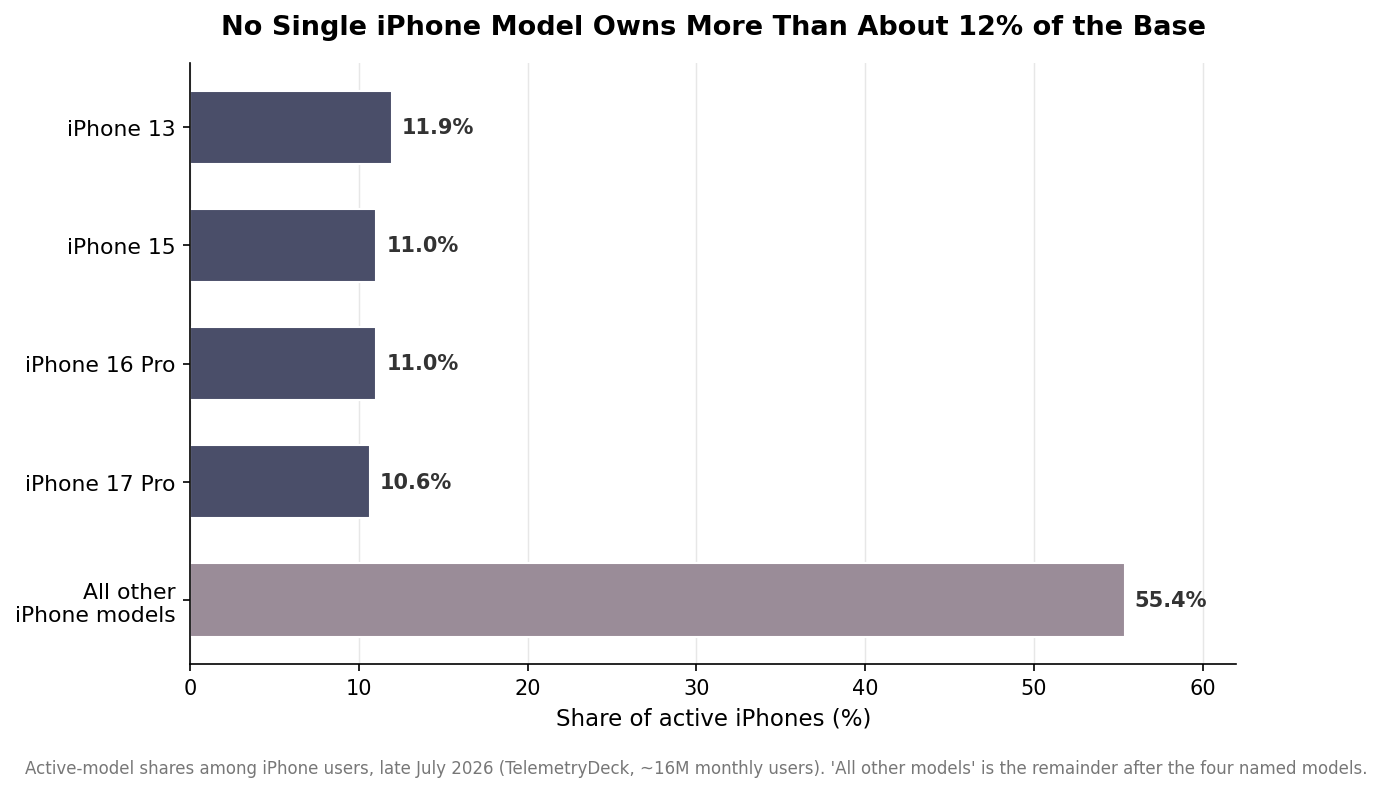
Even once you commit to iPhone, there is no safe single model to standardize on. As of mid-2026, the most-used iPhone was the iPhone 13 at only about 11.9 percent of the active base, followed by the iPhone 15 and iPhone 16 Pro near 11 percent each and the iPhone 17 Pro around 10.6 percent. The important pattern is that the leader sits near twelve percent, not fifty. Demand is spread across a long tail of models spanning several years, because people keep phones for years and buy across the lineup, from the newest Pro Max down to hand-me-down older units.
For a case buyer, that fragmentation is the whole challenge. Covering just the single most popular model reaches barely one in eight iPhone owners. Reaching a meaningful majority of iPhone users means stocking a handful of models across at least two or three generations, which multiplies your SKU count and your total order. The realistic goal is not full coverage but smart coverage of the models that concentrate the most demand for your specific audience.
Match Your SKU Spread to Your Audience
Translate those shares into a plan by working from the top down. Start with the current flagship generation, since new-phone buyers are the most likely to want a fresh case, then add the one or two prior generations that still hold double-digit share. A common, defensible starting spread is the newest standard and Pro sizes plus the previous generation’s equivalents, which captures recent buyers without gambling on older models that are aging out. Add Android bodies in proportion to the audience split from the first section rather than as an afterthought, and if you serve a global market, a leading Samsung Galaxy flagship or two belongs in the plan.
Quantity per model should follow share, not vanity. It is better to order deeper on three or four proven models than to spread a thin, identical quantity across a dozen bodies, because the thin approach guarantees you sell out of the popular ones while the rare-model cases sit. Let the percentage each model commands guide how many units you commit to it, and hold a little budget back to reorder the winners once real sales tell you which bodies move.
Where Model Planning Goes Wrong
The most common mistake is ordering for the phone in your own pocket instead of the market. Your personal device is one data point out of a fragmented field, and a run built around it usually misses where demand actually sits. A close second is chasing the brand-new model too aggressively at launch, before its share has climbed, which leaves you holding cases for a phone whose owners have not all upgraded yet. The opposite error, clinging to a model that is sliding down the charts, leaves you with bodies that fit fewer phones every month.
Two mechanical mistakes hurt just as much. Forgetting that each model needs its own quantity line turns a tidy budget into a much larger commitment once you add the fifth or sixth SKU. And ignoring size-family overlaps, where a standard and a Plus of the same generation are different molds, quietly doubles your count when you assumed one case would serve both. Map every model and size to its own line before you total the order, so the SKU count does not surprise you at checkout.
A Simple Model-Coverage Plan
Put it on one page before you buy. Name your audience and its rough iPhone-to-Android split, list the current flagship generation and the one or two prior generations worth covering, decide which Android bodies the split justifies, and set a per-model quantity weighted toward the highest-share devices. Confirm the quantity for each SKU and add the size variants as separate lines. Then keep a reorder reserve so you can go deeper on whatever actually sells. A plan built on where phones actually are, rather than on the one you happen to own, is the difference between cases that move and a shelf of bodies that fit almost nobody.