When a phone case is sold as MagSafe compatible, the label is doing a lot of quiet work. It is a claim about magnets, about wireless charging, and about tolerances measured in fractions of a millimeter. For anyone ordering custom cases at volume, understanding what that claim actually rests on is the difference between a case that snaps satisfyingly onto a charger and one that sags, slips, or refuses to charge at full speed. This explainer breaks down the standard behind the marketing so you can specify a custom case that genuinely lives up to it.
What “MagSafe compatible” actually means
Apple’s MagSafe system, introduced on the iPhone 12, combines three things in the phone: a ring of magnets for alignment, a central alignment magnet, and the wireless charging coil beneath them. A genuine MagSafe accessory talks to the phone and can charge at the higher MagSafe rate. Most cases you will see described as MagSafe compatible are not Apple-certified; instead they embed their own magnet ring positioned to line up with the phone’s, so magnetic chargers, wallets, mounts, and stands attach in the right spot. That distinction matters when you write a spec. Compatible cases can align and hold accessories reliably, but the phrase is not a guarantee of certified charging speed, so it is worth stating in your order whether you need certified performance or simply dependable magnetic alignment. The same wording covers a wide quality range, from cases with a full, well-aligned ring to ones with a token magnet that aligns loosely, so treating it as a starting point for questions rather than a finished answer will save you disappointment later.
Inside the magnet ring
The heart of a compatible case is a circular array of small neodymium magnets set into the back shell, over the charging zone. Aftermarket rings commonly use high-grade neodymium, often cited as N52, because the grade determines how much holding power you get from a thin, unobtrusive ring. Holding power is the number buyers actually feel: a well-designed magnetic case will resist somewhere in the range of 800 to 1,100 grams of pull before an attached accessory lets go. That is enough to hold the phone on a car vent mount or dangle it briefly from a charger without dropping. Too weak and wallets slide off in a pocket; too strong is rarely the problem. Because the magnets sit under the printed surface, the artwork itself does not interfere, but the ring must be aligned precisely to the phone model, which is why model-specific tooling matters for a custom run.
Charging speed: MagSafe versus ordinary Qi
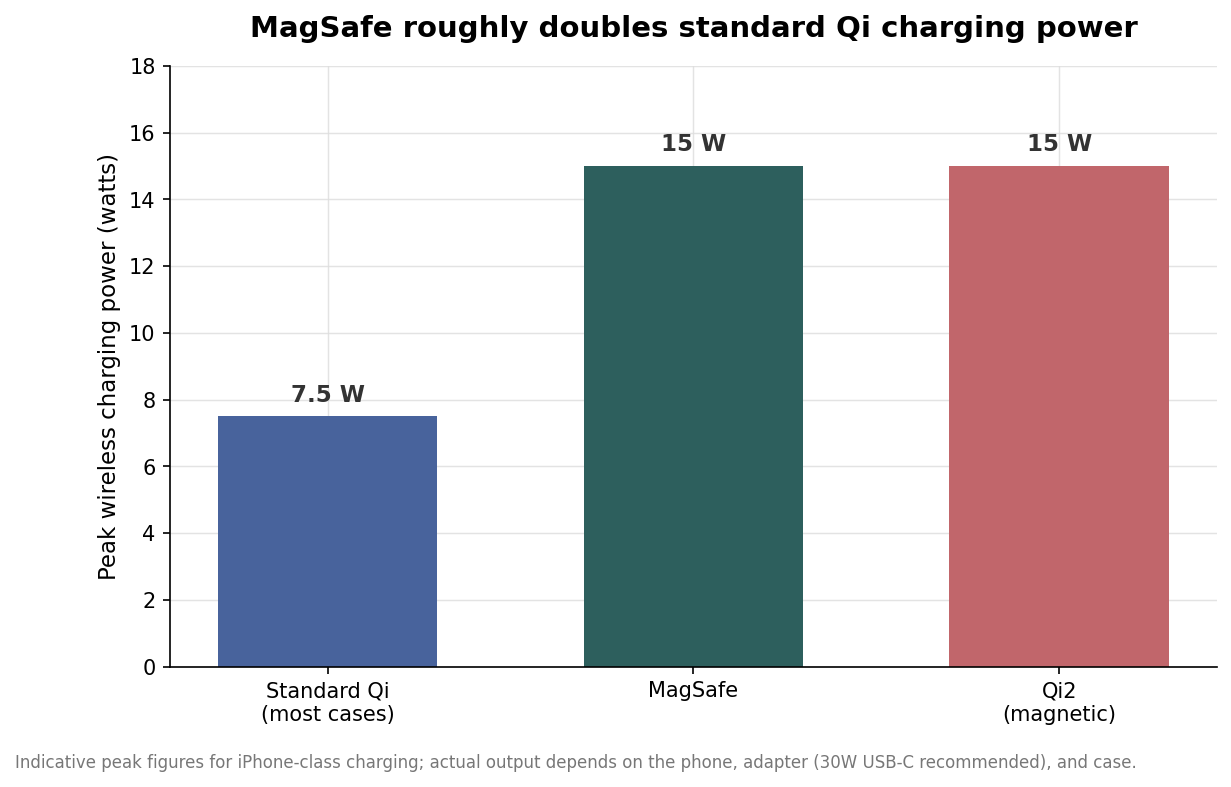
Speed is where the certified-versus-compatible line shows up most clearly. Apple’s MagSafe charging delivers up to about 15 watts to the phone, roughly double the 7.5 watts that a typical case gets from a standard Qi pad. The newer Qi2 standard borrows MagSafe’s magnetic alignment ring and also targets 15 watts, which is bringing magnetic, faster wireless charging to a wider range of phones beyond Apple’s. To reach those peak figures the phone generally needs an adequate power source behind the charger, and Apple recommends a 30-watt USB-C adapter for the fastest results. A compatible case that aligns well but is not certified may still charge, just at the slower Qi rate. The chart below shows the practical gap between these tiers.
Why case thickness is the make-or-break spec
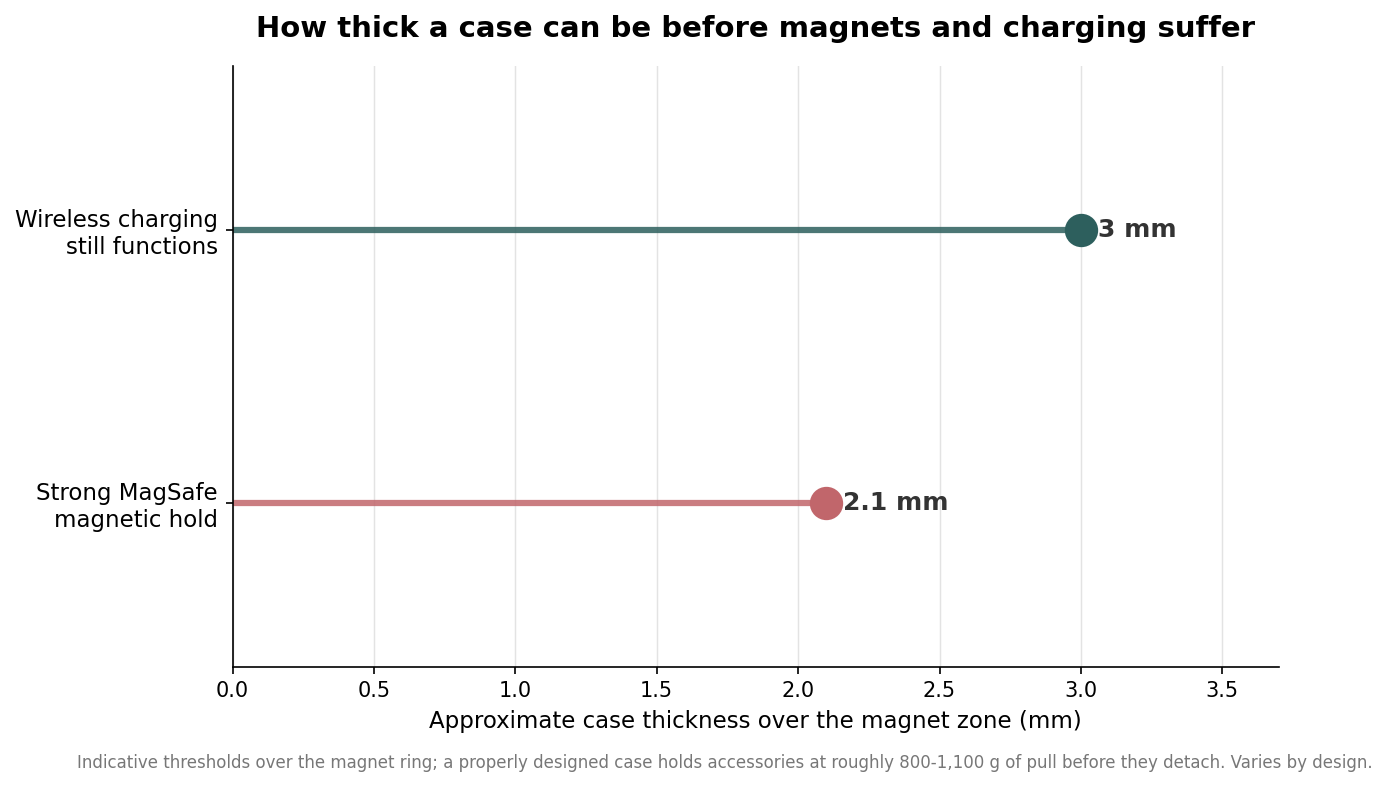
Wireless charging and magnets both work across a gap, and that gap is mostly your case. As a rough guide, ordinary wireless charging keeps functioning through a case up to about 3 millimeters thick over the coil, while a strong, satisfying MagSafe-style magnetic hold really wants the shell over the ring to sit closer to 2.0 to 2.1 millimeters. Every extra fraction of a millimeter weakens both the magnetic grip and charging efficiency, which is why rugged, thick-walled cases sometimes struggle with accessories even when they include magnets. There is also a hard rule about materials: metal plates, metallic foils, or metal-flake finishes over the charging zone can trigger the phone’s Foreign Object Detection, which shuts charging down to prevent overheating. For custom cases this means keeping the magnet-and-coil zone to non-metallic materials and inks. The chart below plots those thickness thresholds side by side.
Built-in magnets versus add-on rings, and what to confirm before ordering
There are two ways to make a custom case magnetic, and they suit different orders. The first is an embedded ring, where the magnet array is built into the case during manufacturing; this is the clean, durable choice for a branded bulk run because there is nothing for the end user to install or misalign. The second is a stick-on magnetic ring applied to a plain case after the fact, which is cheaper per unit but relies on the buyer placing it correctly and can peel over time, making it a poor fit for a professional product. If you are commissioning custom cases, embedding the ring is almost always the right call. Before you sign off, confirm a short list of specifics with your supplier: which exact phone models the tooling covers, whether the case is certified or simply compatible, the shell thickness over the magnet zone, the rated holding force, and that no metallic material or ink sits over the charging window. The figures in this guide are indicative of current mainstream products and vary by design and manufacturer, so treat them as a checklist to pressure-test a quote rather than fixed guarantees. Nail those points down and MagSafe compatible stops being a hopeful label and becomes a spec you can actually hold the factory to.